Looking for answers?
Click on a product name below to view common questions and helpful information specific to that category.
Click on a product name below to view common questions and helpful information specific to that category.
Odometer tampering - also known as odometer interference, odometer fraud, winding back of odometer is the illegal resetting or alteration of a vehicle's odometer to suggest a vehicle has travelled less distance than it really has.
This can result in buyers overpaying for a used car, motorcycle, truck, campervan, or other vehicle, and facing unexpected maintenance costs due to missed servicing intervals.
Both analogue and digital odometers are vulnerable to tampering. Newer vehicles with digital control units or computers may allow odometers to be replaced or re-programmed using fraudulent software.
Checking for inconsistencies that may suggest odometer tampering is a crucial step before buying any used vehicle, including cars and passenger vehicles (utes, sedans, hatchbacks, SUVs), motorcycles (motorbikes, mopeds), campervans, trucks, and buses.
Odometer tampering is on the rise and a common risk in the second-hand vehicle market. A manipulated odometer can mean overpaying or facing unexpected maintenance costs.
AutoCheck's Odometer Check is designed to help you detect odometer fraud and buy with greater confidence, whether you're considering cars and passenger vehicles (utes, sedans, hatchbacks, SUVs), motorcycles (motorbikes, mopeds), campervans, trucks, or buses.
AutoCheck is committed to transparency in the used vehicle market, helping you avoid costly mistakes and make safer buying decisions.
AutoCheck's Odometer Check uses the VIN (Vehicle Identification Number) and odometer reading (optional) you provide to analyse data from independent third-party sources across the automotive industry. The check assesses whether odometer records for your vehicle are recorded in sequential, ascending order by date.
No odometer readings are returned or displayed except the value you enter.
The result will indicate either that your odometer falls within the expected range or that further investigation is recommended.
This practical tool is available for a wide range of eligible vehicles including cars and passenger vehicles, motorcycles, campervans, trucks, buses - to help you detect odometer fraud and buy with greater confidence.
AutoCheck is a fully automated web service.
Once you’ve submitted your request, your Odometer Check results will be displayed instantly in a popup window. You can save or print your results right away.
NO odometer readings are returned or displayed except the odometer you have entered.

If our check determines that records in the database are in sequencial ascending order you will receive a result indicating that the odometer reading falls within expected range.

If there is some discrepancy with the odometer readings recorded in the database not running in sequential increasing order you will receive a result indicating that more investigation is required.
View examples of Odometer Check results before purchasing:
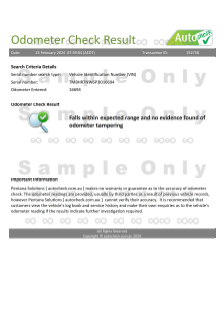
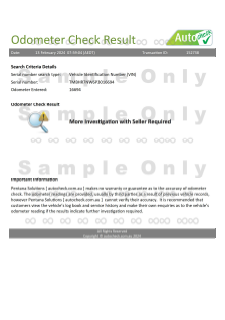
Pentana Solutions trading as autocheck.com.au makes no warranty or guarantee as to the accuracy of odometer check results. Odometer readings are provided by third parties based on previous vehicle records, and their accuracy cannot always be verified. If results indicate further investigation is required, we recommend reviewing the vehicle’s log book, service history, and making your own enquiries regarding the odometer reading.
The VIN (Vehicle Identification Number) is the prime identifier of vehicles such as cars, motorcycles, buses, trucks, and campervans.
It is critical you provide the correct VIN when requesting an Odometer Check, as all results are generated based on the information you supply.
Learn more about VIN or Chassis Numbers.
If you do not have the current odometer reading, AutoCheck will still perform the check using the VIN you provide. The result will be based only on records within our database from independent third-party sources to determine if odometer readings are recorded in ascending order by date.
YES – Accuracy matters. Please personally inspect the vehicle to ensure you have the correct VIN and odometer reading before requesting an Odometer Check.
Incorrect information may result in an unsuccessful check or an invalid report. No refund will be issued for incorrect details supplied.
NO – The Odometer Check does not return odometer data. Only the result of the check is displayed on your certificate.
If you were unable to view, save, or print your Odometer Check at the time of purchase, AutoCheck allows you to retrieve results up to 3 days after the transaction.
Click here to access the Previous Certificates page.
If you still cannot retrieve your results, please email AutoCheck Support with details of the vehicle and the purchase date. Our team will provide you with a copy of your Odometer Check Report by return email.
The Personal Property Securities Register (PPSR) is the official Australian Government register of security interests in personal property - such as cars, motorcycles, trucks, caravans, campervans, trailers, buses, boats, and jet skis.
Established on 30 January 2012, it replaced older state-based registers (like REVS (Register of Encumbered Vehicles) VCheck, VSR and WOVR), providing a single, national online system used to check if used vehicles or boats have outstanding debt (encumbrances).
The PPSR is managed by the Registrar of Personal Property Securities. Anyone can search the PPSR for a small fee, using a vehicle’s VIN (Vehicle Identification Number), chassis number, or HIN (Hull Identification Number) to check if the vehicle or boat is listed as security for a loan or debt (known as a 'security interest' or 'encumbrance').
A PPSR Certificate provides a legal record of your search and shows whether a security interest - such as a debt or loan (encumbrance) - is registered against personal property, such as a motor vehicle or boat at the time of the search.
The certificate is designed to be kept as proof, ensuring you can show you acted with due diligence if a dispute arises regarding ownership or debt.
Details shown on a PPSR Certificate include:
This certificate helps buyers avoid purchasing a vehicle that may be repossessed, is at risk of repossession, has been written off, or has been reported stolen.
You can search for a wide range of vehicles and watercraft, including:
To search, you will need a VIN (Vehicle Identification Number), chassis number, or HIN (Hull Identification Number). Number plates and engine numbers cannot be used for a PPSR search.
A PPSR search helps you avoid costly mistakes like buying a vehicle with money owing, outstanding debt, or encumbrance - which could result in repossession. It also checks for stolen or written-off status, helping you make a safer, more informed decision.
This is especially important when buying from a private seller, as vehicles are sold “as is” and you may not be protected if there are hidden financial interests.
Simply enter the vehicle, trailer, or watercraft’s VIN, chassis number, or HIN into the AutoCheck search tool.
Follow the prompts to pay securely by PayPal, credit, or debit card. Your official PPSR Certificate will display instantly in your browser for you to view, save, or print.
For vehicles built before 1989, use the chassis number. For boats or jet skis, use the HIN/Boatcode.
Always double-check the number you enter by inspecting the vehicle or paperwork. The PPSR search will not return results by registration plate or engine number.
NEVDIS (National Exchange of Vehicle and Driver Information System) is a database supplied by state and territory road agencies and police. NEVDIS provides additional vehicle information for PPSR Certificates, including written-off status, stolen status, make and model details, and registration information.
NEVDIS data is not always available or up-to-date. Its absence does not affect the validity of your PPSR Certificate for confirming financial encumbrances (debt) on your vehicle.
The PPSR certificate remains valid for its intended purpose, and refunds are not provided when NEVDIS data is unavailable or incomplete.
If your PPSR Certificate displays ‘There is no security interest or other registration kind registered on the PPSR against the serial number in the search criteria details,’ it means no financial encumbrances, debt, or money owing are recorded against the identifier (VIN, Chassis, or HIN) you searched.
This helps protect you from the risk of repossession, provided you conducted your PPSR search on the day you purchased the vehicle.
If your PPSR Certificate shows a security interest is registered, it means there may be money owing on the vehicle. The financier or lender (the secured party) has registered their interest and may have the right to repossess the vehicle if the debt is not paid.
Before purchasing, talk to the seller and ask them to clear any outstanding debt and remove the registration.
Buying a vehicle with a registered security interest puts you at risk of repossession if the seller still owes money.
If you proceed with the purchase, make sure you obtain a new PPSR Certificate showing no interest on the day you buy the vehicle. Only a PPSR Certificate without security interests issued at the time of purchase protects you from the risk of repossession.
If your PPSR Certificate shows ‘no data’, ‘no additional information’, or multiple results under NEVDIS, it may be due to one of the following reasons:
Even if NEVDIS information is unavailable or incomplete, your PPSR Certificate will still show any security interests registered against the serial number you searched.
If most fields display ‘no data recorded’, NEVDIS has the identifier in their database but does not have vehicle description or registration details. If information about written-off or stolen status exists, it will be displayed.
A lack of NEVDIS (National Exchange of Vehicle and Driver Information System) data does not void your PPSR Certificate. The PPSR certificate is still valid for its intended purpose, confirming financial encumbrances (debt) on your vehicle. The PPSR/AutoCheck does not provide refunds when NEVDIS data is unavailable or incomplete.
A PPSR Certificate does not confirm:
The current cost to obtain a PPSR Certificate is shown on the AutoCheck website.
Search fees are non-refundable, so ensure all information is correct before submitting.
You should do a PPSR search as close as possible to the time you intend to buy.
The certificate is only valid for the date it is generated, which ensures you have the most up-to-date protection against repossession or undisclosed encumbrances.
A PPSR Certificate is a legal record of your search.
If you buy a vehicle and later a security interest is claimed, you can use your certificate as evidence of your due diligence.
If you purchased from a licensed dealer, you may have additional protection under state or territory laws.
First, ensure you have entered the correct VIN, chassis number, or HIN.
If the details are still incorrect, proceed with caution - this may indicate tampering or an error in NEVDIS. Contact the seller and your state or territory road authority for verification.
No - search fees are non-refundable.
Always check your VIN, chassis number, or HIN carefully before submitting your search.
Once you complete your PPSR search, your certificate is displayed instantly on screen. You can save or print it immediately.
If you need to retrieve your certificate within 3 days of purchase, visit the Previous Certificates page or contact AutoCheck Support for assistance.
For more information about the PPSR, visit the official PPSR website or contact your state or territory road authority. For issues regarding your AutoCheck search or certificate, contact AutoCheck Support.
The Car History Report is a comprehensive report on the history of a used motor vehicle that has been registered in Australia. It is designed to alert you to potentially significant information about a second-hand vehicle before you buy.
Car History Report includes:
The AutoCheck website is a fully automated web service. To request a Car History Report, simply follow the onscreen prompts. After the steps have been successfully completed, the report will display in a popup window. You can then save the report to your PC or print it.
The Car History Report is a comprehensive report on the history of a used motor vehicle registered in Australia. It is designed to alert you to potentially significant information about a second-hand vehicle before you buy.
You will require the following information to successfully complete a Car History Report:
*The VIN is the prime identifier of the vehicle and it is critical you provide the correct information when generating your Car History Report. A VIN is the identification number attached to motor vehicles manufactured on or after 1 January 1989.
Click here to read more about VIN or Chassis Numbers
NO – A 17-character VIN is required to generate a Car History Report.
If the VIN is not 17 characters long, double-check to ensure you have the right VIN and have copied it correctly. If the VIN is still less than 17 characters, it is most likely from a pre-1989 vehicle. Prior to 1989, VINs varied in length from 11 to 17 characters.
YES – The VIN is the prime identifier of the vehicle and it is critical you provide the correct VIN number for the vehicle you are searching. Before you request a Car History Report, personally inspect the vehicle you are intending to purchase to ensure the identifiers you have supplied are correct. Failure to provide the correct number may result in your Car History Report not being successful or the report being invalid. No refund will be issued for incorrect information supplied.
The information presented in the report is current from Car History's various database sources only at the time that the report is obtained. In particular, it is important to note that encumbrance status on a vehicle is only valid on the day of purchase. To protect yourself, we recommend that you purchase a PPSR Certificate on the day you take ownership of the vehicle.
NO – Car History Reports do not confirm ownership of a vehicle.
YES – Every Car History Report includes a PPSR Certificate (formerly REVS Certificate) within the results confirming if there are any encumbrances on the VIN nominated.
NO – A Car History Report will not show how much money is owing on a vehicle.
The Australasian New Car Assessment Program (ANCAP) awards a star rating from 1 to 5 for vehicles, depending on the level of occupant protection provided by the vehicle in serious front and side crashes. The higher the ANCAP star rating, the better the vehicle performed in the tests.
The physical vehicle details, including make, model, engine number, colour, fuel type, registration status, odometer reading and registration expiry date, will only be returned and displayed on the report if they have been recorded and are available. The information on a Car History Report is from a database comprised of many different data sources provided by industry or individuals. It is only as accurate and up-to-date as what has been entered into government and national databases, and we rely on the availability of this data from third-party supplier data sources. There will be occasions where vehicle data is not available.
If you were unable to view, save, or print your Car History Report at the time of transaction and need to retrieve it again, the AutoCheck website allows members of the public to retrieve their reports up to 3 days after the transaction was processed.
Click here to go to the Previous Certificates page of AutoCheck.
If you are still unable to retrieve your report, you can contact AutoCheck Support Staff by email at autocheck@registrationsolutions.com.au with the details of the vehicle and the date that the Car History Report was purchased, and we will provide you with a copy by return email.
VCheck provided buyers of second-hand vehicles with a quick and easy way to obtain important vehicle information prior to purchase. VCheck was available for cars, trucks, caravans, campervans, trailers, buses, and motorcycles that had a VIN (Vehicle Identification Number) and were manufactured after January 1989.
The VCheck Certificate enabled purchasers to verify if the vehicle had a stolen status recorded, and if there was a repairable or statutory write-off. It also detailed the type of damage sustained (e.g. fire, water damage), along with the date and state where the vehicle was written off.
AutoCheck was an Authorised Broker for Queensland Transport and the Office of Fair Trading, and provided a public interface to generate VCheck Certificates via our website. This service ceased in February 2012.
For enquiries, additional information, or issues regarding VCheck Certificate results, please contact Queensland Transport on 13 23 80.
The Register of Encumbered Vehicles (REVS) was a database where financial institutions that loaned money for the purchase of a vehicle registered their security interest. Vehicles on this register were generally referred to as encumbered or having an interest recorded against them, meaning there could have been money owing on the vehicle or the vehicle may not have been owned outright.
AutoCheck was an Authorised Broker and offered an interface to enable members of the public to generate REVS Certificates via our website. This service ceased in 2012.
For enquiries, additional information, or issues regarding REVS Certificate results, please contact the Queensland Office of Fair Trading on 13 13 04.
Hail or Flood Damage
Written Off Information
Stolen Status
Financial Encumbrance
Odometer Tampering
Hail, floods and storms can leave damage that isn’t obvious at first glance. Some affected vehicles may be recorded as repairable write-offs – so looks alone don’t tell the whole story.
Look beyond the shine and check before you buy.
Odometer tampering is a common risk in the second-hand market. A manipulated odometer can mean overpaying or facing unexpected maintenance costs.
A PPSR Certificate + Odometer Check is designed to help you detect odometer fraud and buy with greater confidence.
Read more about AutoCheck's Odometer Check.
Financial risks aren’t always obvious when buying second-hand. If a vehicle has an outstanding debt or security interest, you could end up losing money through repossession or hidden costs.
A PPSR Certificate will reveal any financial encumbrance and other concerns, so you know your investment is secure.
Safeguard your investment.
Read more about PPSR Certificates.
Every certificate and report we offer is designed to highlight important details about a wide range of eligible vehicles and watercraft, including: cars and passenger vehicles (utes, sedans, hatchbacks, SUVs), motorcycles (motorbikes, mopeds), caravans, campervans, camper trailers, trucks, buses, boat trailers, horse floats, tractors, forklifts, ATVs, as well as boats and jet skis. *VIN or HIN is required.


